
Cylindrical Paper Cans: Models, Manufacturing, Printing and Price
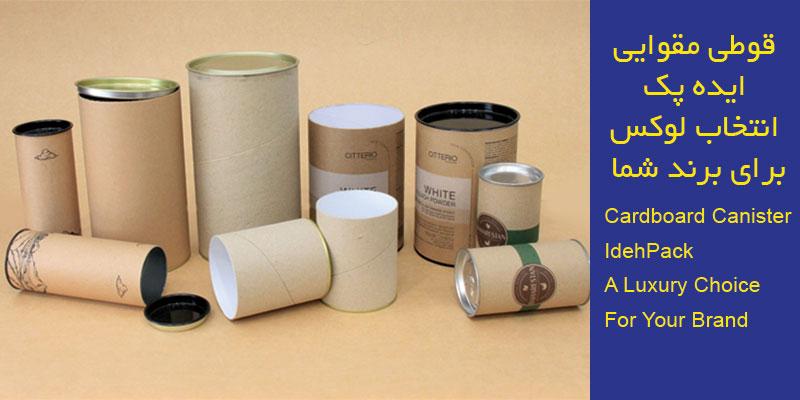
A cylindrical paper can is packaging whose body is made from a cardboard tube and, with a matching lid and base, is used for food, cosmetic, industrial and gift products. Idehpack produces paper cans in 10 models and diameters from 33 to 110 mm, and every step — from design to label printing — is done to order in-house at Idehpack.
What is a cylindrical paper can?
A cylindrical paper can is made from one or two cardboard tubes (single-tube or telescopic). Its round shape gives a continuous side surface that allows 360-degree printing on the label. The inner lining is metallized or white, and the lid and base are metal, cardboard, plastic or screw-type depending on the model.
Idehpack paper can models
| Model | Main feature | Diameter (mm) | Minimum order |
|---|---|---|---|
| Single-tube paper can with metal press-fit lid | One-piece body, metal base, metal press-fit lid | All diameters | 1,000 units |
| Telescopic cardboard can | Two-piece, outer lid slides over the body; induction seal | 33 to 110 | 1,000 units |
| Screw-cap cardboard can | Idehpack design; two-piece plastic or crystal lid (ring and cap), metal base | 83 | 1,000 units |
| Easy-open paper can with metal pull-tab lid | Metal easy-open lid, metal base | 73, 83 and 99 | 1,000 units |
| Paper tube packaging with plastic shaker | Three-mode plastic shaker lid, Idehpack's own mold, optional clear cap | 56 | 5,000 units |
| Windowed paper can with clear PVC wrap | Clear 25-micron PVC window | 83 and 99 | 1,000 units |
| Paper can with 10-sided PET window | Seamless clear 10-sided PET window | 56, 83 and 99 | 1,000 units |
| Paper tube with paper lid and bottom | Telescopic, all-cardboard body, lid and base; no metal, fully recyclable | 33 to 110 | 4,000 units (33 and 37 mm: 12,000 units) |
| Paper tube with piggy-bank lid | Metal lid with a coin or card slot; for money boxes and promotional gifts | 73, 83 and 99 | 1,000 units |
| Idehcap composite jar lid | Plastic lid with a printed cardboard cover for jars and glass bottles | Jar 53 and 76; bottle 70 | 6,000 units |
Idehpack diameters: 33, 37, 56, 67, 73, 83, 99 and 110 mm; can height is made to order.
Applications of cylindrical paper cans
- Paper tube packaging for nuts & dried fruit
- Paper tube packaging for coffee & tea
- Paper tube packaging for spices & salt
- Paper tube packaging for sawiq, granola & grains
- Paper tube packaging for cosmetics & personal care
- Cylindrical hardbox for perfume and cologne
- Paper tube packaging for pet food
- Paper tube packaging for pencils & stationery
- Paper tube packaging for toys & kids products
- Paper tube packaging for industrial parts & products
- Paper tube packaging for seeds & fertilizer
Advantages and limitations
| Advantages | Limitations |
|---|---|
| Professional shelf appearance and 360-degree printing | The cardboard body is not suitable for packing liquids directly (for honey or jam jars, the Idehcap lid is used) |
| Wide choice of models, diameters and heights | Less resistant than metal cans and glass |
| Suitable for transport and export | Sensitive to moisture if the wrong inner lining is chosen |
| Recyclable cardboard body | Costs more than a plain box or kraft bag |
| An attractive unboxing experience | More economical at higher volumes |
How paper cans are made
- Specification: diameter, height, lid model and inner lining (metallized or white)
- Label design and printing: offset printing with finishes such as cellophane lamination, raised UV, gold foil and silver foil
- Tube forming: winding cardboard layers into a cylindrical body
- Cutting the tube to the ordered height
- Fitting the base and lid for the model
- Labeling and quality control
- Packing and shipping
Label printing and design
Labels are offset printed, and finishes such as cellophane lamination, raised UV, gold foil and silver foil can be applied. On some models, such as the metal press-fit lid and the screw cap, the logo can also be embossed on the lid. Label design is done in-house at Idehpack, and required product information such as name, weight, ingredients, dates and barcode is placed on the label.
What affects the price of a paper can?
| Factor | Details |
|---|---|
| Size | Can diameter and height |
| Model | Single-tube, telescopic, screw-cap, easy-open, windowed and more |
| Lid and base | Metal, cardboard, plastic, screw or easy-open |
| Inner lining | Metallized or white |
| Printing and finish | Print type and label effects |
| Order volume | The unit price falls as volume rises |
Paper cans compared with other packaging
Paper can vs. metal can
| Criterion | Paper can | Metal can |
|---|---|---|
| Weight | Light | Heavy |
| Shipping cost | Low | High |
| Custom printing | 360-degree label printing | More limited |
| Recycling | Recyclable cardboard body | Recyclable through metal recycling |
| Suitable for liquids | No | Yes |
Paper can vs. plastic container
| Criterion | Paper can | Plastic container |
|---|---|---|
| Appearance | Printed label with premium finishes | Simpler |
| Environment | Recyclable cardboard body | Plastic |
| Price | Medium | Usually cheaper |
| Printing | 360-degree label printing | More limited |
Paper can vs. glass container
| Criterion | Paper can | Glass container |
|---|---|---|
| Weight | Light | Heavy |
| Breakage | Does not break | Breakable |
| Shipping cost | Low | High |
| Product visibility | With windowed models | Fully transparent |
For premium glass products, the paper can is used as secondary packaging.
Paper can vs. plain box and kraft bag
| Criterion | Cylindrical paper can | Plain box / bag |
|---|---|---|
| Strength | Higher | Lower |
| Price | Medium | Cheaper |
| 360-degree printing | Yes | No |
FAQ
Which paper can models does Idehpack make?
Ten models: single-tube with metal press-fit lid, telescopic, screw-cap, easy-open, salt-shaker lid, round windowed, 10-sided windowed, paper tube with paper lid and bottom, piggy-bank, and the Idehcap jar lid.
What is the minimum order?
1,000 units for most models; 5,000 for the salt-shaker can, 4,000 for the paper tube with paper lid and bottom (12,000 for 33 and 37 mm) and 6,000 for the Idehcap jar lid.
Can I order a small quantity?
Yes. Orders under 1,000 units of available models are handled through the Idehpack online shop.
What is the inner lining?
Metallized or white, depending on the product.
Which printing is available?
Offset printing with finishes such as cellophane lamination, raised UV, gold foil and silver foil.
How is the price calculated?
Based on size, model, lid and base, inner lining, printing and order volume.
Request a quote via the Idehpack contact page.
ثبت دیدگاه